

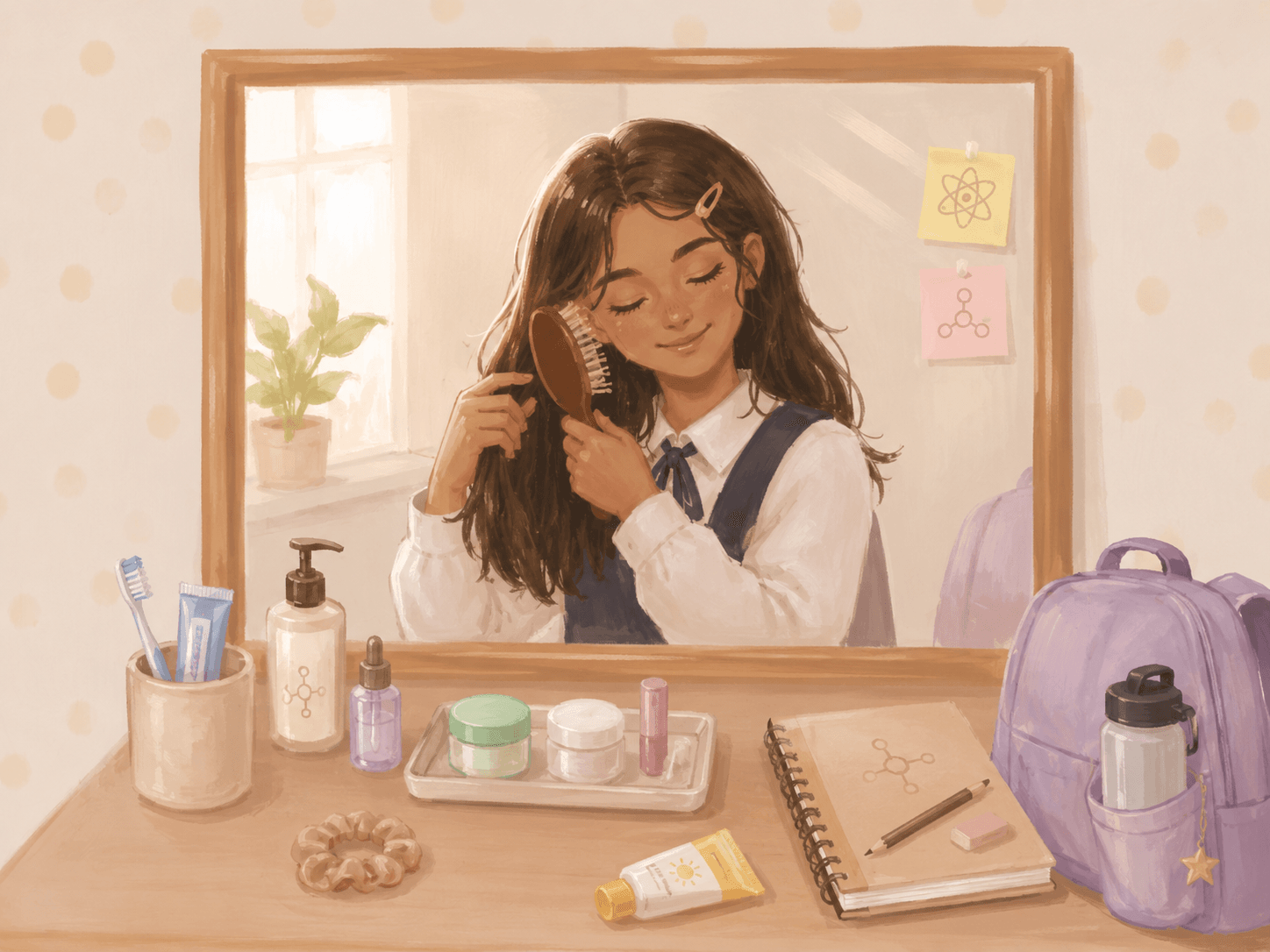
Before you even leave the house, you may have used chemistry, biology, physics, engineering, and materials science without realizing it.
That face wash on your bathroom counter? Chemistry.
The sunscreen you apply before school? Chemistry and biology.
The curls, coils, braids, waves, or straight strands you style in the mirror? Biology and physics.
The perfume, lotion, lip gloss, nail polish, sneakers, jacket, and backpack you choose for the day? STEM is hiding in all of it.
STEM does not only live in laboratories, rockets, robots, or computer screens. It is woven into everyday life, including the small routines many girls already know, enjoy, question, and care about. Beauty, skincare, haircare, fragrance, fashion, and cosmetics are full of science and innovation. Once you start looking closely, your morning routine becomes a mini STEM lesson.
Skincare Is Chemistry in Action
Every cleanser, moisturizer, serum, and sunscreen is designed with chemistry in mind.
Cleansers help remove oil, sweat, dirt, and makeup from the skin. Moisturizers are created to help support the skin barrier and reduce water loss. Sunscreens are formulated to help protect skin from ultraviolet rays. Acne products often use ingredients that target oil, bacteria, clogged pores, or inflammation.
That means cosmetic chemists, dermatologists, biologists, and product developers all play a role in creating the products people use every day.
Even something as simple as choosing a moisturizer involves science. Some ingredients help attract water. Some help seal moisture in. Others help smooth or protect the skin. The goal is not just to make something feel nice, but to understand how skin works and how different ingredients interact with it.
Haircare Uses Biology, Physics, and Engineering
Hair is not “just hair.” It has structure, texture, porosity, elasticity, and strength.
Hair porosity, for example, describes how easily hair absorbs and holds moisture. Curl patterns are influenced by the shape of the hair follicle. Heat styling changes the way hair behaves, while humidity can affect how hair holds shape. Products like gels, oils, creams, conditioners, and heat protectants are designed to work with different hair types and styling goals.
There is also engineering involved. Think about flat irons, curling wands, blow dryers, diffusers, detangling brushes, and protective styling tools. Someone had to design those tools, test how they work, consider safety, study heat distribution, choose materials, and improve the user experience.
The next time you use a hair product or styling tool, remember: there is a whole world of STEM behind how it was made.
Makeup and Cosmetics Are Full of Materials Science
Makeup may look like color and creativity, but it is also materials science.
Lip gloss has to shine, spread smoothly, and stay comfortable. Mascara has to coat lashes without clumping too much. Foundation has to blend, match skin tones, and wear well throughout the day. Nail polish has to flow onto the nail, dry into a film, and resist chipping.
That does not happen by accident.
Cosmetic scientists study pigments, waxes, oils, polymers, powders, and preservatives. They test texture, color payoff, stability, safety, packaging, and performance. A product has to look good, feel good, and work the way people expect it to work.
Even color matching involves science. Undertones, light reflection, pigment blending, and how products appear on different skin tones all matter. Creating inclusive beauty products requires both technical skill and thoughtful design.
Fragrance Is Chemistry, Memory, and Art
Perfume and scented products are another example of STEM meeting creativity.
Fragrance development involves chemistry because scents are made from different aromatic compounds. Some notes are light and fade quickly. Others last longer and give a fragrance depth. Perfumers and fragrance chemists think about how scents change over time, how they mix with skin, and how they make people feel.
There is also a connection between scent and memory. A certain lotion, shampoo, or perfume can remind you of a person, a place, or a moment in your life. That connection involves the brain, emotions, and sensory science.
Fragrance is not just “smelling good.” It is chemistry, biology, psychology, and design working together.
Fashion Has More STEM Than You Think
The clothes you wear are full of science and engineering.
Fabric can be breathable, stretchy, waterproof, insulating, lightweight, flame-resistant, or moisture-wicking. Athletic wear is designed to support movement and manage sweat. Winter coats use materials that trap heat. Rain jackets use fabric technology to help repel water. Shoes are engineered for support, grip, comfort, and performance.
Fashion designers, textile scientists, engineers, and sustainability experts all help shape what we wear.
There is also growing innovation around sustainable fashion. Scientists are developing new materials, improving recycling methods, reducing waste, and exploring better ways to produce clothing. That means fashion can connect to environmental science, chemistry, engineering, and global problem-solving.
STEM Is Already Part of Your World
One of the biggest myths about STEM is that it only belongs to certain kinds of people.
The “math kid.”
The robotics kid.
The future doctor.
The person who already knows how to code.
But STEM is much bigger than that. It belongs to the girl who reads ingredient labels. The girl who loves doing nails. The girl who mixes skincare products and wonders what each one does. The girl who experiments with hairstyles. The girl who sketches outfits. The girl who notices that a product does not work well for her hair, skin tone, body, or lifestyle and thinks, “Someone should fix this.”
That thought, right there, is the beginning of innovation.
STEM starts with curiosity. It starts with noticing how things work, asking better questions, and imagining how something could be improved. It can be creative, personal, stylish, practical, and fun.
So the next time you get ready for the day, take a closer look. Your routine may seem ordinary, but it is full of science. And somewhere behind every product, tool, fabric, fragrance, and formula, there are people using STEM to create, test, improve, and solve problems.
Maybe one day, one of those people will be you.


