
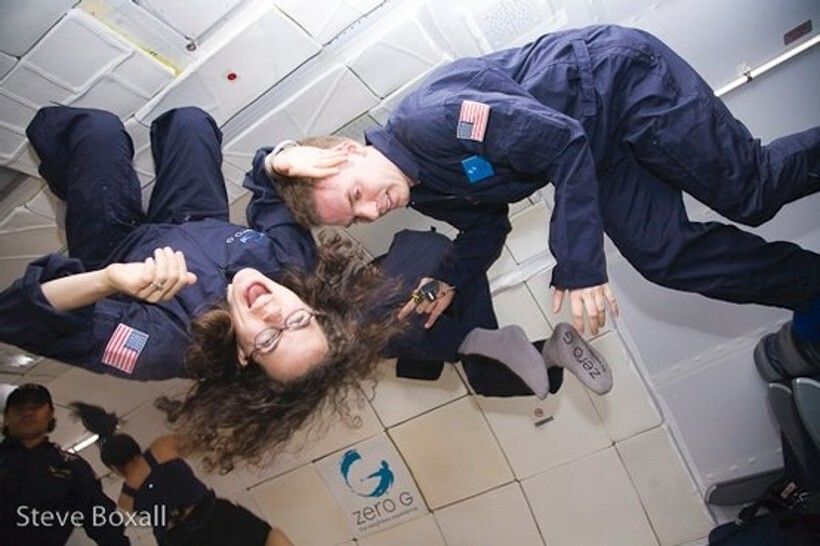
For as long as she can remember, Dr. Erika Wagner has been fascinated by space.
At just five years old, her parents gave her a telescope because her excitement about space was already impossible to miss. A fourth-grade field trip to Space Camp only deepened that passion. Growing up in a close-knit family that encouraged curiosity through camping trips, soccer games, science museums, and exploration, Erika’s dreams were given plenty of room to grow.
Today, Dr. Wagner is helping shape the future of space exploration as the Lead for U.S. Sales and Strategy at The Exploration Company. Her career has included leadership roles at Blue Origin, the XPRIZE Foundation, MIT, and numerous organizations advancing commercial spaceflight and scientific discovery. She is an Associate Fellow of the American Institute of Aeronautics and Astronautics, a Fellow of the American Society for Gravitational and Space Research, and has served on multiple boards and panels for the National Academies.
As a Biomedical Engineering student at Vanderbilt University, Erika became especially interested in how humans adapt to space. Along the way, she met astronauts, mentors, and professionals who expanded her understanding of what a career in space could look like. Her summer internships introduced her to research laboratories, government agencies, and aerospace organizations, including Johns Hopkins Applied Physics Lab, Boeing, Lockheed, Marshall Space Flight Center, and Johnson Space Center.
Then came a moment she still remembers vividly.
While serving as a drill instructor on a marching band field, Erika looked up and saw the Space Shuttle passing overhead, carried piggyback on a Boeing 747. Tears filled her eyes.
“That sealed the decision,” she recalls. “A career in space.”
From there, Erika doubled down on graduate school, eventually earning a master’s degree in Aeronautics and Astronautics from MIT and a PhD in Bioastronautics from the Harvard-MIT Division of Health Sciences and Technology.
Another defining moment came in 1999, when Erika volunteered as a docent at the U.S. Space & Rocket Center in Huntsville during the 30th anniversary of Apollo 11. She reported to the main desk and asked how she could help. They assigned her to serve as a dignitary escort for special guests of Buzz Aldrin. After guiding the guests to their table, they invited her to join them. That day, Erika had the opportunity to meet Buzz Aldrin and several other spaceflight heroes.
The experience reinforced a lesson that has stayed with her ever since:
“If you make yourself available to opportunities, the universe has a way of reigniting your spark.”
That message is one Erika loves sharing with young people today. When she speaks with students, she emphasizes that space is not limited to astronauts and aerospace engineers. Modern space missions need people with expertise in medicine, biology, software, design, communications, business, manufacturing, architecture, art, and countless other fields.
“Space is opening its doors wider and wider,” she says. “There is a place for everyone.”
Erika also encourages students to think beyond the familiar phrase, “If she can see it, she can be it.” Role models matter deeply, but so does imagination. Sometimes, she reminds young people, it is possible to become something you have never seen before.
That spirit comes through beautifully in Erika’s TEDxRainier talk, where she reflects on what is possible in this “third age” of spaceflight:
“What’s happening now in this third age of space flight is that the frontier is opening. And when it opens from being just the right stuff, we get to see all that other stuff that makes us so profoundly human. It’s not just the scientists and the engineers, but the artists, the poets, the dancers, the dreamers… There are a dozen companies worldwide making spaceships for the rest of us… Technology has a way of being democratized. We are seeing that right now on the space frontier.”
It is exactly this kind of vision that makes Erika such a moving and enlightening speaker, and why AstraFemina is so fortunate to have her as a frequent speaker and member.
Another theme Erika highlights is that “Moonshots are also Earth shots.” The technologies and innovations developed for space exploration often improve life here on Earth, creating benefits far beyond their original purpose.
While Erika once pursued the dream of becoming an astronaut herself, her focus has expanded over time. Today, she finds deep fulfillment in helping others reach their potential. She remains active with organizations including the Museum of Flight in Seattle, the Brooke Owens Fellowship, and the Aurelia Institute, where she helps create opportunities for the next generation of explorers and innovators.
Outside of her professional work, Erika is the mother of two teens and the wife of her longtime sweetheart, a Boeing engineer she met at band camp. She still plays the French horn and even had a concert scheduled the afternoon of her interview.
Erika has also watched firsthand how each generation imagines space differently. She recalls a Boy Scout event where her son William was surprised to learn that rockets sometimes fly only once. To him, reusable rockets seemed like the obvious way things should work. For Erika, that moment illustrated something powerful: every generation begins with a larger vision of what is possible than the one before.
As she looks ahead, Erika’s goals have become both simpler and deeper: to be happy, to make an impact, and to help open doors for others.
One final thing matters deeply to her. Erika is delighted that many organizations now embrace STEAM rather than STEM alone. Science and technology are essential, but so are creativity, communication, and the arts.
The future, she believes, will belong to those who can bring all of those strengths together.
Through her work, mentorship, leadership, and imagination, Dr. Erika Wagner is helping ensure that the future of space is open to everyone.


