
When people hear the word STEM, they often picture doctors, engineers, astronauts, scientists, or computer programmers.
And yes, those careers are real, exciting, and important. But STEM is much bigger than the jobs most people already know.
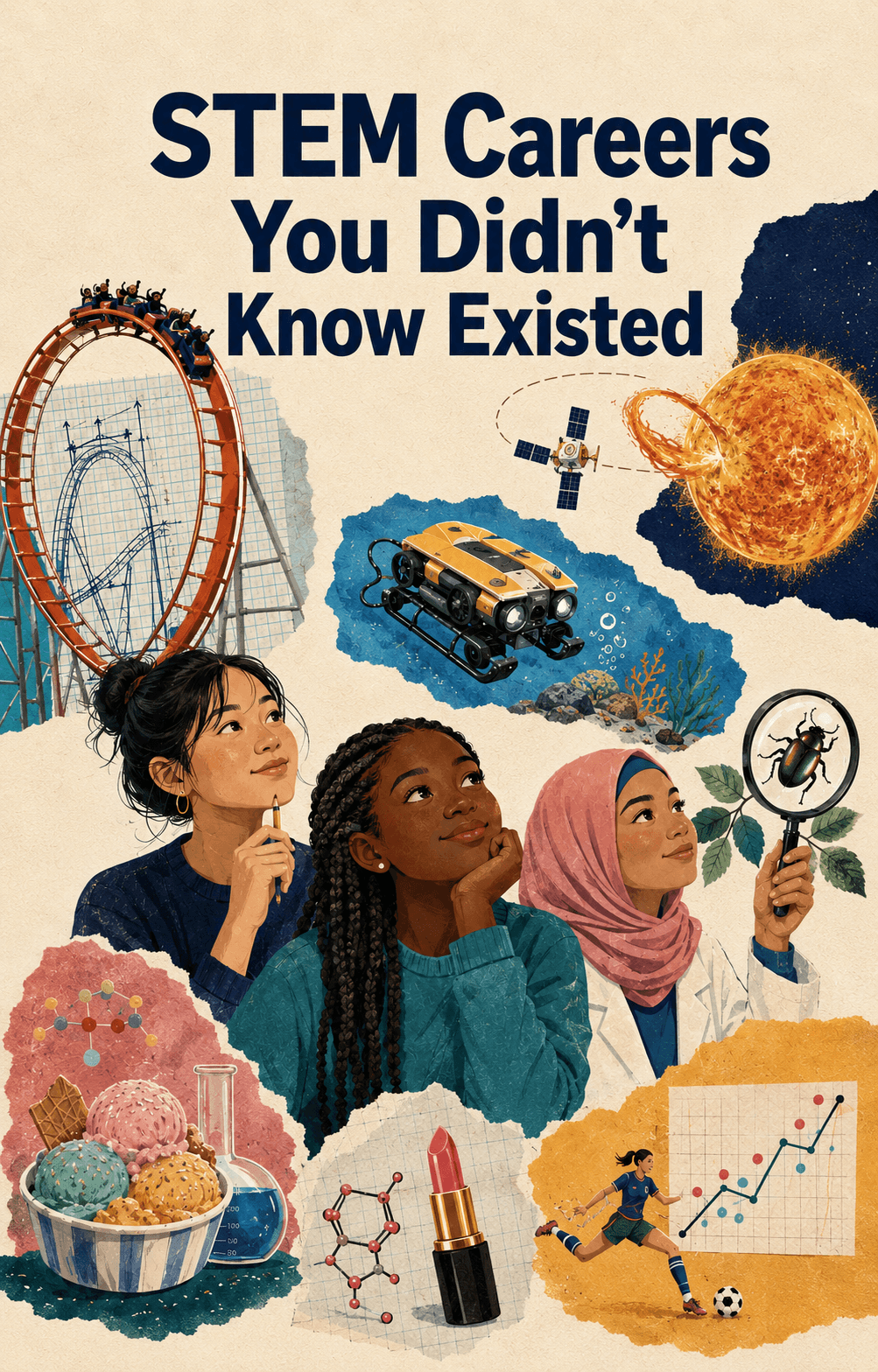
STEM can mean designing roller coasters. Studying insects at crime scenes. Creating new ice cream flavors. Tracking solar storms. Building underwater robots. Protecting people during natural disasters. Helping athletes perform better. Making makeup safer, smoother, and more inclusive.
Some STEM careers sound almost made up, but they are very real. Even better, they show that STEM is not one narrow path. It is a world full of curiosity, creativity, problem-solving, and unexpected possibilities.
Here are a few STEM careers you may not have heard of yet.
Food Flavor Chemist
Have you ever wondered who creates the taste of a new chip, candy, drink, cereal, or ice cream flavor?
That could be the work of a food flavor chemist.
Food flavor chemists use chemistry to study taste, smell, ingredients, and how flavors work together. They help create new food products, improve recipes, and make sure flavors stay consistent from one batch to the next.
This career combines science and creativity in a very real way. A flavor chemist might study why vanilla tastes warm, why citrus feels bright, why chocolate pairs well with certain ingredients, or how to make a snack taste smoky, spicy, sweet, or savory.
If you love food, experiments, and asking “what would happen if we mixed this with that?” this career might be worth exploring.
Forensic Entomologist
This one sounds like it belongs in a mystery show.
A forensic entomologist studies insects, especially how they can help investigators understand what happened at a crime scene. Insects can provide clues about time, location, and environmental conditions.
It may sound unusual, but it is a real scientific field that uses biology, ecology, observation, and careful evidence collection.
This career is a good reminder that STEM is not always neat, shiny, or predictable. Sometimes it is muddy, strange, and incredibly important.
If you are the kind of person who notices tiny details others miss, forensic science might have a place for you.
Space Weather Scientist
Yes, space has weather.
Space weather scientists study activity from the Sun, including solar flares, solar wind, and geomagnetic storms. These events can affect satellites, GPS systems, radio communication, power grids, and even astronauts in space.
This career connects astronomy, physics, technology, and Earth systems. It is the kind of job where studying the Sun can help protect technology here on Earth.
Space weather scientists help answer questions like:
What is happening on the Sun?
Could it affect satellites or communication systems?
How can we prepare for solar storms?
What risks might astronauts face beyond Earth?
If you love space but do not necessarily want to become an astronaut, this is one of the many STEM paths that still connects you to the universe.
Theme Park Engineer
Roller coasters do not build themselves.
Theme park engineers help design rides, attractions, safety systems, animatronics, water features, special effects, and interactive experiences. Their work can include mechanical engineering, electrical engineering, structural design, computer science, physics, and human factors.
A theme park ride has to be fun, but it also has to be safe, reliable, and carefully tested. Engineers think about speed, motion, materials, weather, emergency systems, guest experience, accessibility, and long-term maintenance.
This career is perfect proof that engineering can be creative.
If you have ever walked through a theme park and wondered, “How did they make this feel so real?” there is a good chance STEM helped create the magic.
Medical Illustrator
Medical illustrators combine science and art to create images that explain the human body, diseases, surgeries, medical devices, and health concepts.
Their work might appear in textbooks, patient education materials, research papers, medical animations, websites, or training tools for doctors and nurses.
To do this job well, a medical illustrator needs to understand anatomy, biology, medicine, design, and visual storytelling. They help make complicated information easier to understand.
This is a great example of a career for someone who loves both science and drawing. You do not always have to choose between being “the science person” and “the art person.” Some careers need both.
Ethical Hacker
An ethical hacker uses cybersecurity skills to find weaknesses before criminals do.
Companies, hospitals, schools, banks, and government agencies all need people who can test their systems and protect sensitive information. Ethical hackers may look for security gaps in websites, apps, networks, or devices.
The goal is not to break things for harm. The goal is to protect people.
Ethical hackers use logic, creativity, coding, research, and problem-solving. They have to think like an attacker while acting with responsibility and integrity.
If you like puzzles, mysteries, technology, and outsmarting problems, cybersecurity may be a STEM field to explore.
Sports Data Analyst
Sports are full of STEM.
A sports data analyst studies numbers to help teams, coaches, trainers, and athletes make better decisions. They might analyze player performance, injury risk, game strategy, training patterns, or scouting data.
This career uses math, statistics, computer science, and communication. It is not enough to collect data. Analysts also have to explain what the data means and how it can help a team improve.
Sports data can answer questions like:
Which strategy works best against a certain opponent?
How is an athlete’s performance changing over time?
What patterns show up before an injury?
Which player might be undervalued?
If you love sports and problem-solving, this career might surprise you.
Cosmetic Chemist
A cosmetic chemist helps develop products like lotions, shampoos, sunscreens, lipsticks, mascaras, foundations, cleansers, and hair products.
They study ingredients, textures, safety, stability, color, scent, and performance. They test how products feel, how long they last, how they interact with skin or hair, and how they hold up over time.
Cosmetic chemistry matters because people need products that work for different skin tones, hair textures, sensitivities, climates, and lifestyles.
This career brings together chemistry, biology, materials science, creativity, and consumer needs.
If you have ever wished a product worked better for you, that thought could be the beginning of a STEM idea.
Disaster Response Technologist
When hurricanes, wildfires, floods, earthquakes, or other emergencies happen, technology can help save lives.
Disaster response technologists use tools like mapping systems, drones, satellite images, communication networks, sensors, databases, and emergency planning software to help communities prepare for and respond to disasters.
Their work can help answer urgent questions:
Where is flooding happening?
Which roads are blocked?
Where do people need help?
How can emergency teams communicate?
What areas are most at risk next time?
This career shows how STEM can directly support people during some of the hardest moments of their lives.
If you want a career where technology meets service, this is a powerful path to know about.
Underwater Roboticist
Underwater roboticists design, build, or operate robots that explore places humans cannot easily go.
These robots may be used to study the ocean, inspect bridges or ships, search underwater wreckage, collect scientific samples, repair equipment, or support environmental research.
This career can involve mechanical engineering, electrical engineering, computer science, ocean science, sensors, cameras, navigation systems, and robotics.
The ocean is still full of mystery, and underwater robots help us explore it safely.
If you are fascinated by the sea, machines, exploration, or environmental science, this career is one to remember.
STEM Is Bigger Than You Think
One of the best things about STEM is that it does not look the same for everyone.
You can love art and become a medical illustrator.
You can love makeup and become a cosmetic chemist.
You can love sports and become a data analyst.
You can love mysteries and become a forensic scientist.
You can love the ocean and build underwater robots.
You can love helping people and work in disaster response technology.
There is no single “STEM personality.” You do not have to fit into a stereotype. You do not have to know your exact path right now. You do not even have to love every STEM subject.
Sometimes, discovering STEM starts with learning that a career exists at all.
So if you have ever thought STEM was too boring, too hard, too technical, or just not “you,” look again. The STEM world is full of careers that are creative, strange, adventurous, helpful, artistic, and surprising.
Some of them sound made up.
But they are real.
And one of them might be waiting for you.


