
When a hurricane approaches the coast, a wildfire spreads toward a community, or flooding threatens homes and businesses, preparation can save lives.
Behind every weather warning, evacuation route, emergency shelter, and safe drinking water advisory is a network of people using science, technology, engineering, and mathematics to protect the public.
Emergency preparedness is not simply about stocking supplies or knowing where to go during a crisis. It involves understanding hazards, predicting what might happen, designing systems that can withstand disaster, and helping communities recover safely afterward.
During National Preparedness Month, we are taking a closer look at the STEM professionals working behind the scenes before, during, and after emergencies.
Predicting Dangerous Weather
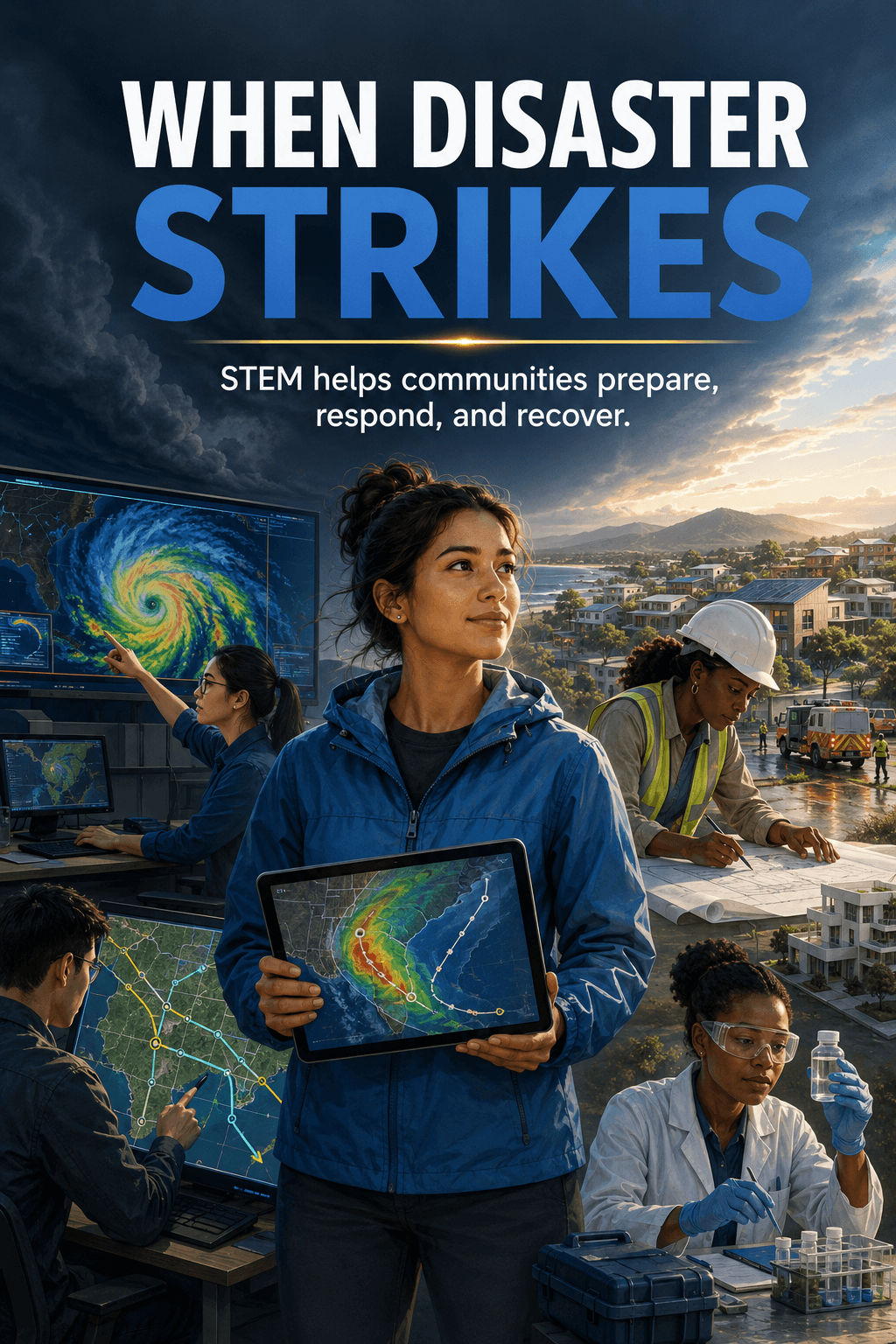
Meteorologists are often among the first people to alert communities that a dangerous event may be approaching.
They use satellites, radar systems, weather stations, computer models, and historical data to monitor atmospheric conditions. By studying changes in temperature, air pressure, wind speed, humidity, and precipitation, meteorologists can identify developing storms and estimate where they may travel.
Predicting weather is not as simple as looking at a single radar image. Atmospheric conditions are constantly changing, and even small changes can affect a storm’s direction or intensity. Meteorologists must analyze large amounts of information, compare multiple forecasting models, and communicate uncertainty clearly.
Their work helps emergency managers determine when to open shelters, issue evacuation orders, close schools, position supplies, or warn residents about dangerous conditions.
Meteorology brings together physics, mathematics, environmental science, computer science, and communication. It is also a powerful example of how data can be transformed into information that helps people make potentially lifesaving decisions.
Engineering Stronger Communities
While meteorologists help predict hazards, engineers help communities withstand them.
Civil and structural engineers design buildings, bridges, roads, drainage systems, levees, and other infrastructure with safety in mind. Depending on the location, they may need to consider hurricane-force winds, earthquakes, flooding, extreme heat, heavy snowfall, or wildfires.
Engineers use mathematics, physics, materials science, computer modeling, and testing to understand how structures may respond under extreme conditions. They may study whether a building can withstand high winds, determine how quickly a drainage system can move stormwater, or select materials that are more resistant to heat and fire.
Engineering also plays an important role after disasters. Engineers inspect damaged buildings, roads, and bridges to determine whether they are safe to use. They help restore essential services and use what they learn from previous disasters to improve future designs.
Every stronger roof, safer bridge, improved stormwater system, and more resilient electrical grid represents STEM being used to protect a community.
Mapping Hazards and Evacuation Routes
During an emergency, location matters.
Which neighborhoods are most likely to flood? Where is a wildfire moving? Which roads remain open? Where are emergency shelters located? Which communities may need additional help evacuating?
Geographic information systems, commonly called GIS, allow professionals to organize and analyze information connected to specific locations. GIS specialists can combine maps with data about weather, roads, population density, elevation, hospitals, utilities, flood zones, and other important factors.
This information can help emergency planners identify vulnerable areas, create evacuation routes, position emergency resources, and decide where assistance is needed most.
GIS technology may also be used to track damage after a disaster. Information collected through satellites, drones, field inspections, emergency calls, and public reports can be added to digital maps, giving response teams a clearer picture of changing conditions.
GIS combines geography, data science, computer technology, and visual communication. It turns complicated information into maps that people can quickly understand and use.
Protecting Public Health After a Disaster
The danger does not always end when the storm passes or the fire is contained.
Disasters can damage drinking water systems, interrupt electricity, contaminate food, displace animals, increase exposure to mold, and create conditions where insects and disease can spread. Floodwater may contain sewage, chemicals, fuel, debris, and other hazards that are not always visible.
Environmental health and public health professionals work to identify these risks and protect communities during recovery.
They may test drinking water, inspect food facilities, assess emergency shelters, investigate possible disease outbreaks, monitor sanitation, evaluate mold and air-quality concerns, and provide guidance for safely cleaning homes and businesses. They also help communities understand whether water must be boiled, which foods should be discarded after a power outage, and how to avoid injuries or illness during cleanup.
Laboratory scientists, epidemiologists, nurses, physicians, environmental health specialists, and emergency response teams often work together to track health concerns and prevent additional harm.
This work demonstrates an important truth about disaster response: protecting public health requires both scientific expertise and the ability to communicate information clearly to people who may already be overwhelmed.
Technology and Data in Emergency Response
Modern emergency preparedness depends heavily on technology.
Computer models can estimate where floodwater may travel. Sensors can detect changes in river levels, air quality, temperature, or ground movement. Drones can survey areas that may be difficult or dangerous for response teams to reach. Emergency notification systems can quickly send warnings to thousands of people.
Data scientists help analyze the enormous amount of information created during an emergency. They may study hospital capacity, power outages, transportation conditions, supply needs, or patterns in emergency calls. Their findings can help leaders decide how to distribute personnel, equipment, food, water, and medical resources.
Technology does not replace human judgment, but it can help emergency teams understand a rapidly changing situation and respond more effectively.
STEM Careers That Help Protect Communities
Emergency preparedness includes far more careers than many students realize. Girls interested in protecting people, solving problems, studying weather, building technology, or strengthening communities can explore careers such as:
- Meteorologist
- Emergency management specialist
- Environmental health specialist
- Public health scientist
- Epidemiologist
- Civil engineer
- Structural engineer
- Environmental engineer
- Geographic information systems specialist
- Hydrologist
- Data scientist
- Computer programmer
- Emergency communications specialist
- Disaster response researcher
- Urban and regional planner
These careers require different types of education and training, but they share a common purpose: using knowledge to help people prepare, respond, and recover.
Some professionals spend their time in laboratories or offices. Others work in emergency operations centers, hospitals, construction sites, government agencies, or directly in affected communities. Many work as part of multidisciplinary teams, combining their expertise to solve problems that no single person or profession could address alone.
Preparedness Is a STEM Challenge
Disasters can be unpredictable, but preparation gives communities options.
STEM professionals help us understand the risks we face, strengthen the systems we depend on, and make informed decisions when conditions become dangerous. Their work can mean earlier warnings, safer buildings, clearer evacuation routes, cleaner water, faster recovery, and fewer lives placed at risk.
For girls considering their futures, emergency preparedness offers an opportunity to see STEM in a deeply human way. It is not only about equations, technology, or scientific research. It is about using those tools to solve urgent problems and protect people when they need help most.
When disaster strikes, STEM is already at work.


