

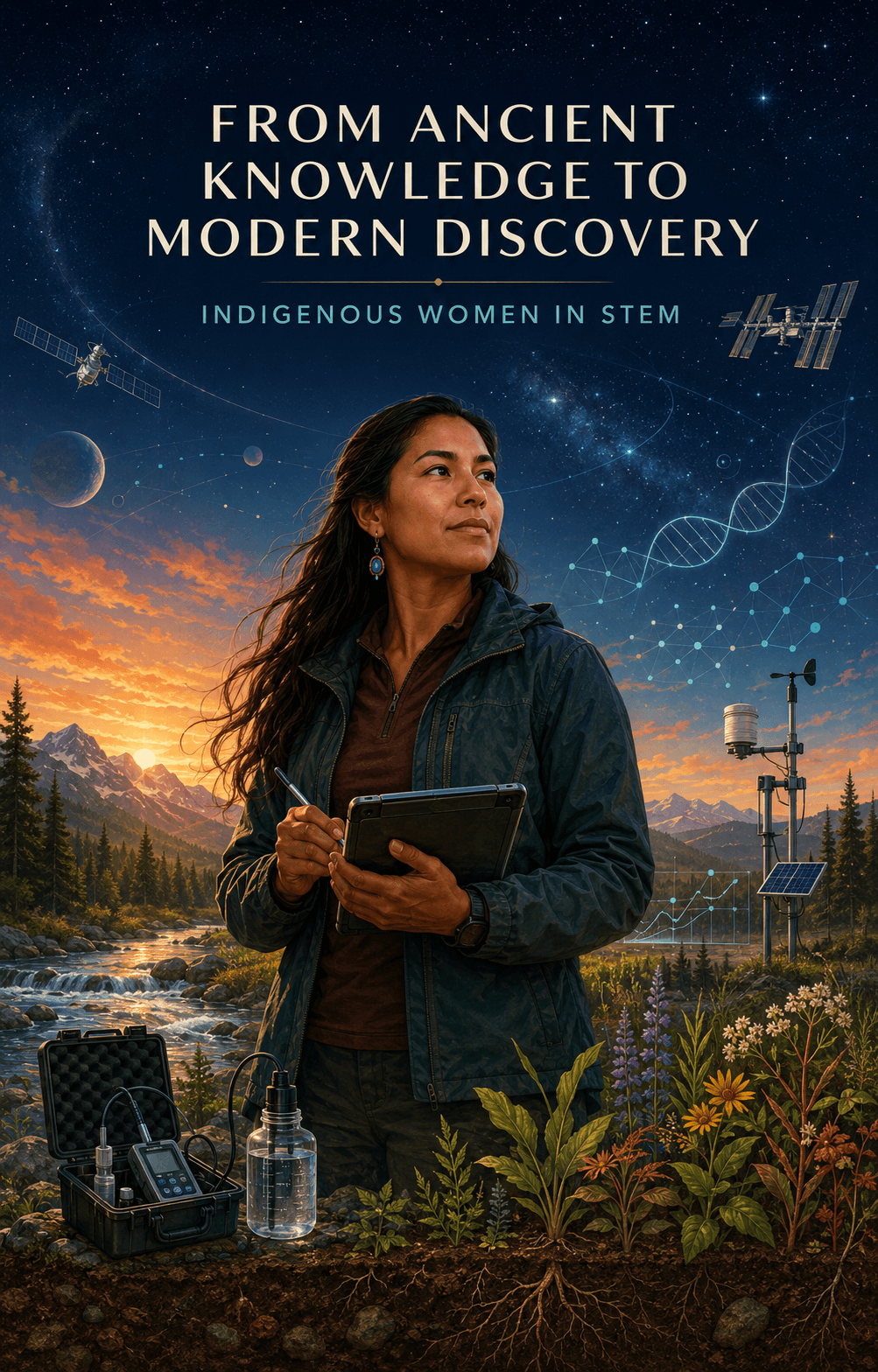
Science does not begin only in laboratories, universities, or research centers.
Long before satellites tracked changes in the climate or scientists collected data using sensors and computer models, Indigenous communities were carefully observing the natural world. They studied the movement of animals, the health of plants, the timing of seasons, the behavior of fire, the flow of water, and the relationships connecting people to the land.
That knowledge was tested through experience, refined across generations, and used to help communities adapt and thrive.
During Native American Heritage Month, we have an opportunity to recognize both the deep scientific knowledge held by Indigenous communities and the Indigenous women advancing discovery today. They are working in ecology, engineering, medicine, genetics, environmental science, space exploration, and many other STEM fields.
Their work also reminds us that scientific progress is strongest when communities are respected as partners, not simply treated as subjects of research.
Knowledge Built Through Observation
Traditional ecological knowledge, sometimes called TEK, is a system of knowledge developed through generations of close relationships with local environments. It may include an understanding of plants, animals, weather, waterways, agriculture, fire, medicine, and seasonal changes.
Although the word “traditional” is sometimes misunderstood to mean old or unchanging, Indigenous knowledge continues to develop. Communities observe new conditions, respond to environmental changes, and apply knowledge in ways that remain relevant today.
In many ways, traditional ecological knowledge and modern scientific research share important foundations. Both rely on observation, identifying patterns, testing ideas, learning from evidence, and passing knowledge to others.
However, Indigenous knowledge often examines relationships more broadly. Instead of studying a plant, animal, or water source as an isolated subject, it may consider how that subject connects to an entire ecosystem, a community, and future generations.
These perspectives can contribute to modern conservation efforts, including:
- Using cultural burning and carefully managed fire to support healthier forests and reduce the risk of catastrophic wildfires
- Monitoring changes in animal behavior, migration, and habitat
- Restoring native plants and culturally important species
- Protecting water sources and responding to contamination
- Understanding how climate change affects specific landscapes
- Developing sustainable approaches to agriculture, fishing, and land management
This knowledge is not a shortcut around scientific research. It is a valuable body of evidence and experience that can work alongside other scientific methods.
Indigenous Women Leading Discovery
Indigenous women are not only preserving knowledge from previous generations. They are producing new research, developing technology, leading laboratories, protecting natural resources, and expanding what is possible in STEM.
Dr. Robin Wall Kimmerer: Plant Ecologist and Educator
Dr. Robin Wall Kimmerer is a plant ecologist, author, educator, and enrolled member of the Citizen Potawatomi Nation. She has studied plant ecology, mosses, ecological restoration, and the role of traditional ecological knowledge in understanding the natural world.
As the founding director of the Center for Native Peoples and the Environment at the State University of New York College of Environmental Science and Forestry, Kimmerer has helped create programs that bring Indigenous knowledge and scientific research together in support of environmental sustainability.
Her work encourages scientists to think not only about what humans can learn from nature, but also about the responsibilities people have to the ecosystems that support them. Through her research and writing, including Braiding Sweetgrass, she has introduced readers around the world to a way of approaching science through observation, relationship, gratitude, and reciprocity.
Learn more about Dr. Robin Wall Kimmerer’s work.
Dr. Karletta Chief: Protecting Water and Indigenous Communities
Dr. Karletta Chief is a Diné hydrologist and environmental engineer from Black Mesa, Arizona. Her research focuses on water, climate change, environmental contamination, and the resilience of Indigenous communities.
Chief has worked with communities affected by the Gold King Mine spill, a 2015 environmental disaster that released contaminated water into rivers flowing through parts of the Navajo Nation. Her work has helped evaluate environmental health risks while making scientific information more accessible to the people most directly affected.
As director of the Indigenous Resilience Center at the University of Arizona, Chief also helps train students to address challenges involving food, energy, and water. Her approach combines technical expertise with cultural understanding and meaningful community participation.
Her career demonstrates that environmental science is not only about collecting samples or studying data. It is also about listening, communicating clearly, and making sure research responds to the needs of the people whose water, land, and health are at stake.
Learn more about Dr. Karletta Chief.
Dr. Krystal Tsosie: Genetics, Bioethics, and Data Sovereignty
Dr. Krystal Tsosie, a citizen of the Navajo Nation, is a geneticist, bioethicist, and genomic data scientist. Her work explores how genetic research can advance health while respecting the rights of Indigenous peoples.
Genetic information can contribute to important medical discoveries, but it also raises difficult questions. Who owns a person’s biological samples? Who decides how genetic data may be used? What happens when information collected for one study is later used for another purpose? How can researchers ensure that communities benefit from studies involving their members?
Tsosie addresses these questions through her research and advocacy for Indigenous data sovereignty, the principle that Indigenous peoples should have authority over data collected from or about their communities.
She also co-founded the Native BioData Consortium, an Indigenous-led research organization and biorepository located on sovereign Tribal land. Its work offers a model for conducting advanced biomedical research while placing Indigenous governance, priorities, and protections at the center of the process.
Learn more about Dr. Krystal Tsosie and the Native BioData Consortium.
Nicole Aunapu Mann: Engineering a Path to Space
NASA astronaut Nicole Aunapu Mann is registered with the Wailacki of the Round Valley Indian Tribes. She earned bachelor’s and master’s degrees in mechanical engineering before becoming a U.S. Marine Corps pilot and test pilot.
In October 2022, Mann launched to the International Space Station as commander of NASA’s SpaceX Crew-5 mission. She became the first Indigenous woman from NASA to travel to space and spent 157 days aboard the station.
During the mission, Mann supported scientific investigations, maintained station systems, and completed spacewalks. Her path from engineering student to pilot, astronaut, and spacecraft commander demonstrates how many different STEM skills come together in space exploration.
Her accomplishment was also a powerful moment of representation. When young Indigenous students see someone from an Indigenous community commanding a spacecraft, the idea of belonging in aerospace, engineering, and exploration becomes easier to imagine.
Learn more about astronaut Nicole Aunapu Mann.
Science Should Be Done With Communities
The contributions of Indigenous knowledge cannot be separated from the rights of Indigenous peoples.
For generations, researchers have sometimes entered Native communities, collected information, biological samples, stories, or cultural knowledge, and then left without providing meaningful benefits or even explaining how the material would be used. In some cases, data gathered for one purpose was later used for unrelated research without adequate consent.
That history has understandably created distrust.
Respectful research requires more than receiving permission from an individual participant. Tribal Nations are sovereign governments, and communities should have a meaningful voice in studies that affect their land, health, culture, resources, and citizens.
Ethical collaboration may include:
- Involving communities when research questions are first developed
- Respecting Tribal approval and review processes
- Clearly explaining how information and samples will be collected, stored, and used
- Protecting knowledge that is private, sacred, or culturally sensitive
- Recognizing Indigenous ownership and stewardship of data
- Sharing results in useful and understandable ways
- Ensuring that research produces benefits identified by the community
- Giving Indigenous experts proper credit for their knowledge and contributions
True partnership changes the question from “What can researchers learn from this community?” to “What can researchers and communities accomplish together?”
More Than One Way to Understand the World
Modern technology can measure temperature, map landscapes, analyze DNA, and model future climate conditions with extraordinary precision. Indigenous knowledge can contribute generations of place-based observation, cultural context, and an understanding of relationships that may not be visible in a single research project.
Neither should be treated as a decoration added to the other. Meaningful collaboration respects them as distinct knowledge systems that can inform one another.
When Indigenous scientists are able to bring their identities, community knowledge, and technical training into their work, they can ask questions that others may overlook. They may identify risks earlier, recognize connections across disciplines, or develop research practices that are more ethical and effective.
That is one of the reasons representation matters in STEM. Different experiences do not weaken science. They help science see more.
Exploring Your Own Path in STEM
You do not need to choose between your culture, your community, and your curiosity. Your experiences may be exactly what helps you notice a problem, ask a better question, or imagine a new solution.
Girls interested in Indigenous knowledge and STEM can begin by:
- Learning about the plants, animals, waterways, and environmental concerns in their own communities
- Talking with family members, cultural educators, scientists, and community leaders
- Participating in science fairs, robotics teams, environmental clubs, or citizen science projects
- Exploring careers in ecology, engineering, medicine, public health, agriculture, astronomy, genetics, and data science
- Looking for programs through Tribal colleges, universities, museums, NASA, and organizations such as the American Indian Science and Engineering Society
- Asking who benefits from research and whose voices may be missing
- Recording observations and developing questions about changes in the natural world
The future of STEM will not be built from one perspective or one way of knowing.
It will be built by people who can connect knowledge with responsibility, innovation with respect, and discovery with the communities it is meant to serve. Indigenous women are already doing that work, from protecting rivers and restoring ecosystems to governing genetic data and exploring space.
Their stories are not simply part of scientific history. They are part of science happening right now.


